
One cubic metre
build volume
We print parts up to 1000 × 1000 × 1000 mm in one piece, using engineering plastics. No moulds or tooling required, even for a single part.
What we print
Composite moulds
Moulds and plugs for glass- and carbon-fibre laminates, up to one metre in one piece. Often faster and more economical than machined or handmade moulds, especially for one-off parts and small batches.
Jigs and fixtures
Assembly jigs, drill guides, fixtures and inspection gauges for production. Tailored to your product, in a material that stays rigid and dimensionally stable.
Discontinued parts
A cover, guide, housing or guard that is no longer available. We scan the original and print a replacement, using a stronger material if needed.
Three large printers in-house
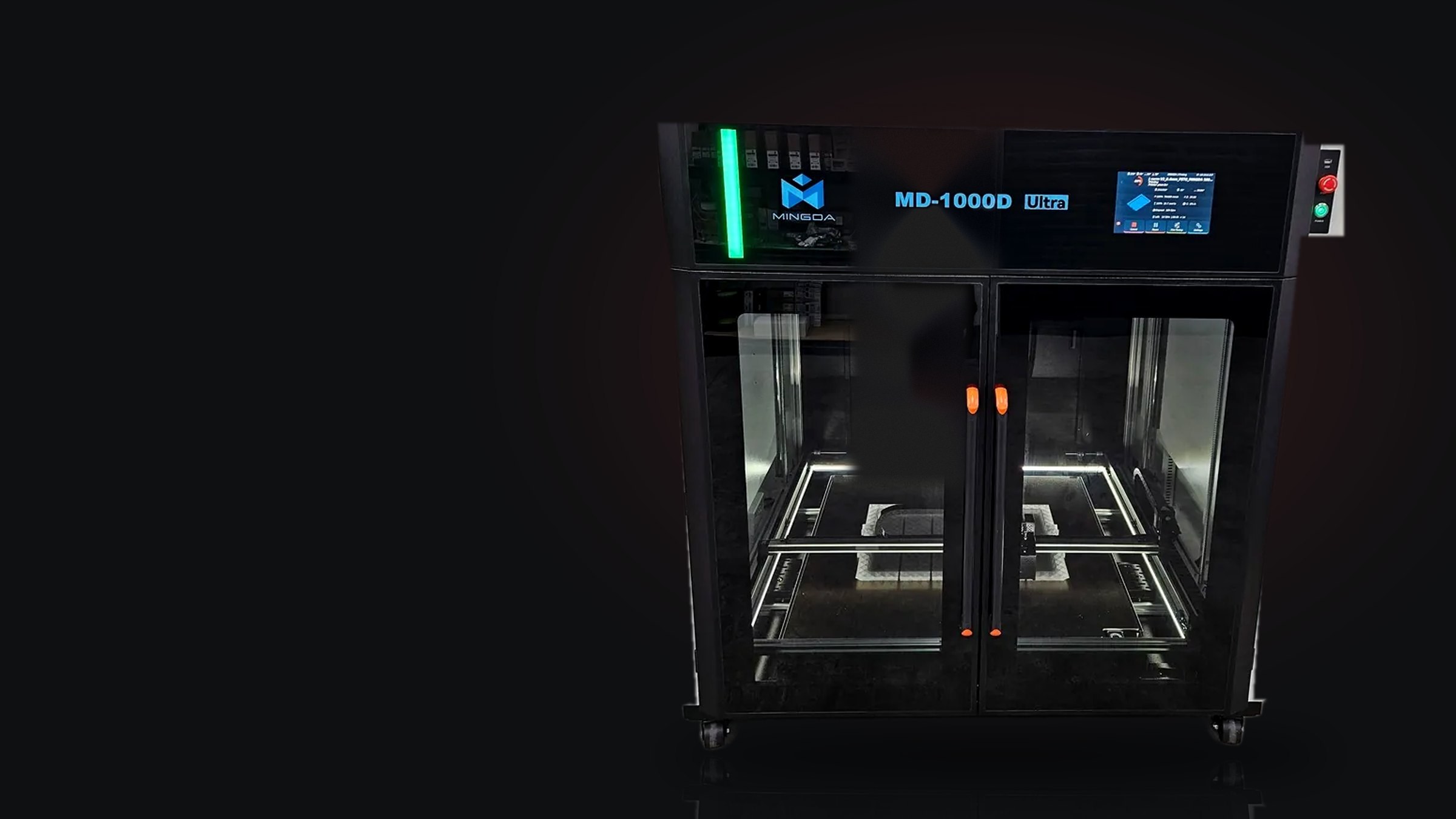
Mingda MD-1000D Ultra
Enclosed, heated chamber (45 °C), two print heads up to 350 °C and a flow rate up to 40 mm³/s. For engineering and fibre-reinforced materials, and shapes requiring soluble supports.
Mingda MD-600D Ultra
The same technology as the larger Mingda: a heated chamber and two print heads up to 350 °C. For medium-sized parts in engineering materials.
Engineering plastics
We select materials for the loads, temperatures and chemicals your part will face, or simply for size and low weight. Unsure? Tell us how it will be used and we will advise you.
- PLA and PETG
- The starting point for large parts, models and moulds. PETG is tough and resistant to many chemicals.
- Carbon- or glass-fibre reinforced
- PETG-CF, PET-CF/GF and ABS-CF/GF: stiffer and more dimensionally stable than base materials. For fixtures, jigs and moulds that need to remain accurate.
- Engineering nylons
- PA12-CF and HtPA-CF/GF: strong, rigid and resistant to higher temperatures. For loaded production parts.
- PPS, PPS-CF and PPS-GF
- High-performance plastic with excellent chemical and high-temperature resistance. For parts in demanding environments.
- Soluble supports
- The second print head deposits support material that dissolves after printing. This makes internal channels and overhanging shapes possible.
We scan the original
Only the old part remains, or the new part must fit an existing installation? We capture the shape with our 3D scanner, on site or in our workshop, then print a replacement.
More about 3D scanningFrom file to part
Request
Send a 3D file (STEP or STL), a drawing or photographs with dimensions. You can also send the original part for scanning.
Advice and quotation
We select material and structure for the part’s purpose. With a 3D file, calculate the print price and the fixed total including shipping immediately.
Printing
Large parts can take several days to print. We tell you the expected completion date in advance.
Delivery
All orders are shipped. Shipping is included directly in the total price. Collection is not available.
Good to know
How large can a print be?
Up to 1000 × 1000 × 1000 mm in one piece. Larger objects are printed in sections and joined afterwards.
Which file should I send?
Preferably a STEP file; STL also works. Without a file, send a drawing or photographs with dimensions, or send the original part for scanning.
How strong is a printed part?
It depends on material and structure. A 3D print is weaker along the build direction than within a layer. We therefore select the orientation according to the loads on the part.
Can you print a single part?
Yes. One-off parts and small batches are where large-format printing is particularly useful, because no mould or tooling is needed.
Something large to print?
Send your file, drawing or photographs with dimensions. You will receive a quotation within one business day.